
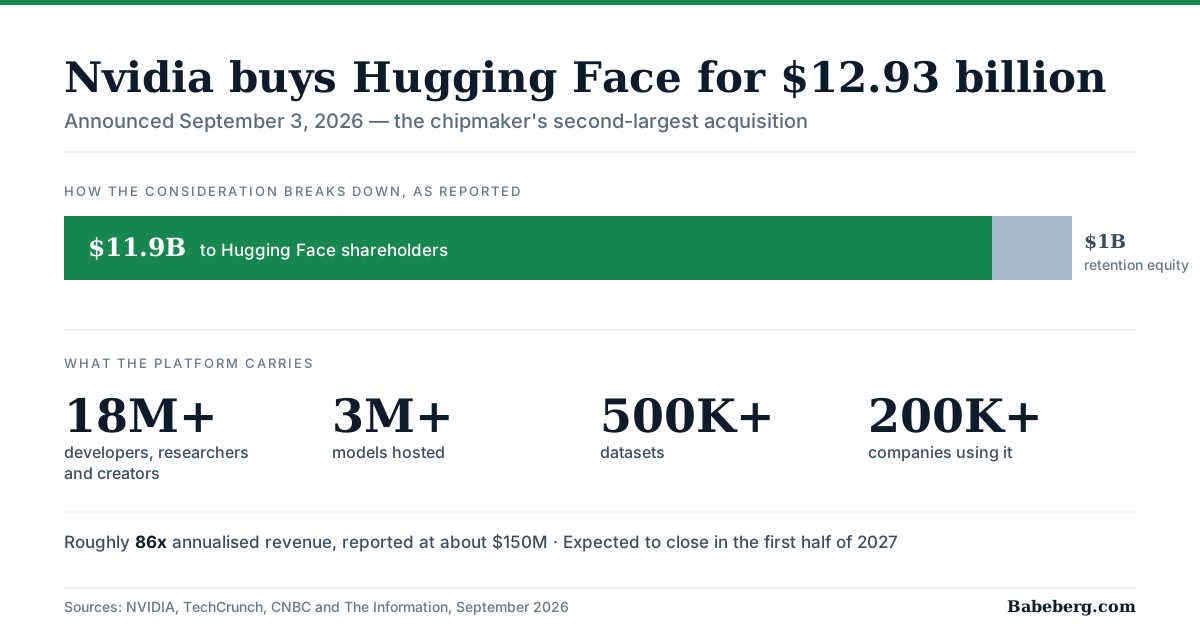
Nvidia has agreed to buy Hugging Face for $12.93 billion, the chipmaker confirmed Wednesday, putting the most widely used repository of open artificial-intelligence models under the ownership of the company that supplies most of the hardware those models run on.
The purchase is Nvidia's second-largest, according to reporting on the deal, behind the roughly $20 billion it paid for Groq's assets late last year. Reporting on the structure put roughly $11.9 billion as consideration to Hugging Face shareholders, with a further $1 billion in equity earmarked to retain Hugging Face employees joining Nvidia. The transaction is expected to close in the first half of next year.
What Nvidia is buying
Hugging Face is not a model developer in the mould of OpenAI or Anthropic. It is the place the industry keeps its work. By Nvidia's own accounting, the platform is used by more than 18 million developers, researchers and creators and by more than 200,000 companies, and hosts more than 3 million models, 500,000 datasets and 1 million applications.
That inventory is the asset. Practically every open-weight model release of the past three years has been distributed through Hugging Face, and a substantial share of the tooling built around open models assumes its presence. Buying it does not buy the models — most are published under open licences by others — but it buys the distribution layer they travel through, and the developer relationships that come with it.
The neutrality question
The obvious tension is that Nvidia sells the compute. A hardware vendor acquiring the neutral ground on which competing models are published invites the question of whether that ground stays neutral, and Nvidia moved to answer it in the announcement rather than waiting to be asked.
"Hugging Face will remain an open platform for the entire AI ecosystem," chief executive Jensen Huang said, adding explicitly that "NVIDIA compute will not be required to build on or deploy through Hugging Face" and that the platform will continue to support open-source and open-weight models from across the industry.
"Together, we will scale Hugging Face's platform, strengthen its infrastructure and expand access to AI for developers and institutions worldwide," Huang said.
Those are commitments rather than contractual guarantees, and they will be read closely by the companies whose models are hosted there — including firms that compete with Nvidia's customers, and increasingly with Nvidia itself. The platform's value rests on being the default place to publish regardless of what silicon a model was trained on; that property is easy to erode and difficult to rebuild.
How the deal came together
Hugging Face approached Nvidia rather than the reverse. Co-founder and chief executive Clément Delangue consulted Huang about a transaction some weeks before it was announced, Delangue told CNBC — a detail that reframes the deal as a company choosing its acquirer rather than one fending off an approach.
The price
The number is large against any conventional measure of the business. Hugging Face was reported by The Information last month to be running at roughly $150 million in annualised revenue, which puts the purchase price at something in the region of 86 times revenue — a multiple that prices strategic position rather than cash flow.
The company has raised more than $395 million since its founding in 2016, most recently a $235 million round in 2023 led by Salesforce Ventures, with participation from Google, Amazon, IBM — and Nvidia itself, which is now buying the whole of what it helped fund.
What comes next
The deal is expected to close in the first half of next year, which leaves it subject to regulatory review in the intervening months. Nvidia's position in AI hardware has drawn sustained attention from competition authorities on both sides of the Atlantic, and an acquisition that places the industry's principal model repository inside the dominant chip supplier is the kind of vertical combination those authorities have said they intend to scrutinise.
For developers, nothing changes immediately: repositories, licences and download endpoints continue as they are. The question the acquisition raises is a longer one — whether the open commons of AI can sit inside a company that sells the means of running it, and remain a commons.
Sources: NVIDIA, TechCrunch and CNBC, September 3, 2026.

0 Comments
No comments yet. Be the first!
Leave a Comment