
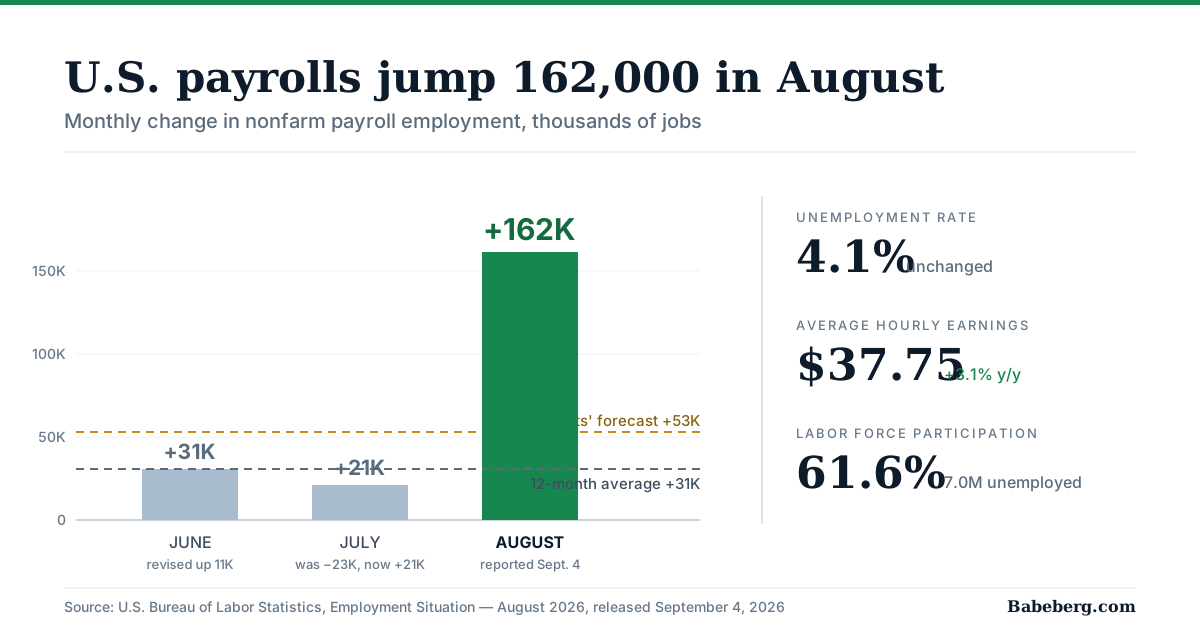
American employers added 162,000 jobs in August, the Labor Department reported Friday morning, a hiring figure roughly three times what forecasters had penciled in and more than five times the average monthly gain of the past year. The unemployment rate held steady at 4.1 percent.
The report, released at 8:30 a.m. Eastern by the Bureau of Labor Statistics, lands as one of the strongest single readings in a labor market that had spent much of the year cooling. Payroll growth has averaged just 31,000 a month over the previous twelve months — a pace that had raised persistent questions about whether hiring was stalling outright. August answered those questions, at least for one month, in emphatic fashion.
Hiring beat forecasts by a wide margin
Economists surveyed ahead of the release had looked for a gain of roughly 53,000 jobs. The actual figure came in more than 100,000 above that mark, the kind of miss that reprices expectations rather than merely nudging them.
The unemployment rate was the quieter half of the report. At 4.1 percent it was unchanged on the month, with 7.0 million people counted as unemployed. Steady joblessness alongside accelerating hiring is the combination policymakers have been hoping for and had not, until now, been getting.
Where the jobs came from
Growth was concentrated rather than broad. Food services and drinking places added 59,000 jobs, the single largest contributor, while local government education added 42,000, largely offsetting a decline in that category the previous month — a swing that owes much to the timing of the academic calendar and the seasonal adjustments applied to it.
Manufacturing added 16,000 and health care 13,000, the latter a notably smaller contribution than the sector has made in recent years. The information sector shed 23,000 jobs, the month's most conspicuous loss.
June and July revised sharply higher
The revisions may matter as much as the headline. June was revised up by 11,000, from a gain of 20,000 to 31,000. July was revised up by 44,000 — and, more consequentially, from a reported loss of 23,000 to a gain of 21,000.
Together the two months added 55,000 jobs that had not previously been counted, and erased what had stood on the books as an outright contraction in July. A summer that read as the labor market rolling over now reads as one that slowed and steadied.
Wages and hours
Average hourly earnings rose 10 cents, or 0.3 percent, to $37.75. Over the past twelve months earnings are up 3.1 percent — comfortably ahead of the pace of consumer price growth in recent readings, but not the sort of acceleration that signals a wage-price spiral.
The average workweek lengthened by 0.1 hour to 34.4 hours. Hours worked tend to move before headcount does, and an increase alongside strong payroll growth points in the same direction as the rest of the report.
Beneath the headline numbers
Two figures temper the enthusiasm.
The labor force participation rate stood at 61.6 percent. It rose on the month, but remains half a percentage point below its January level — a meaningful decline over eight months, and a reminder that part of what has kept the unemployment rate stable is people leaving the labor force rather than finding work in it. The employment-population ratio, at 59.1 percent, was little changed both on the month and since January.
The second is duration. 1.9 million people have been out of work for 27 weeks or longer, accounting for 27 percent of all unemployed workers. Long-term unemployment at better than a quarter of the total is a sign that for those already displaced, re-entry remains difficult regardless of how many jobs are being created.
Markets and the Federal Reserve
Equities slipped and short-dated Treasury yields rose following the release, with market coverage on Friday reporting that traders had raised the odds of an interest-rate increase at the Federal Reserve's meeting later this month. A labor market adding jobs at three times the expected rate removes much of the urgency behind the case for easing, and revives a debate that had appeared largely settled.
Federal Reserve officials have described the labor market as stable in recent public remarks, and this report is consistent with that characterization — arguably more than consistent with it.
What comes next
Attention turns to inflation. Next week's consumer and producer price readings will determine whether a strong labor market is accompanied by renewed price pressure, and those figures are likely to carry more weight in the Fed's September decision than today's payroll number does on its own.
One month does not reverse a trend, and the twelve-month average of 31,000 remains the more sober description of where hiring has been. But August was unambiguously strong, July was not the contraction it appeared to be, and the labor market enters the fall in better condition than it was thought to be in on Thursday.
Source: U.S. Bureau of Labor Statistics, Employment Situation — August 2026, released September 4, 2026.

0 Comments
No comments yet. Be the first!
Leave a Comment