
Author: Stan Switaj
Anthropic, the company behind the AI assistant Claude, made its IPO paperwork public on Monday, October 26, 2026. It plans to list its Class A shares on the Nasdaq Global Select Market under the ticker ANT, with Goldman Sachs and Morgan Stanley leading the offering.
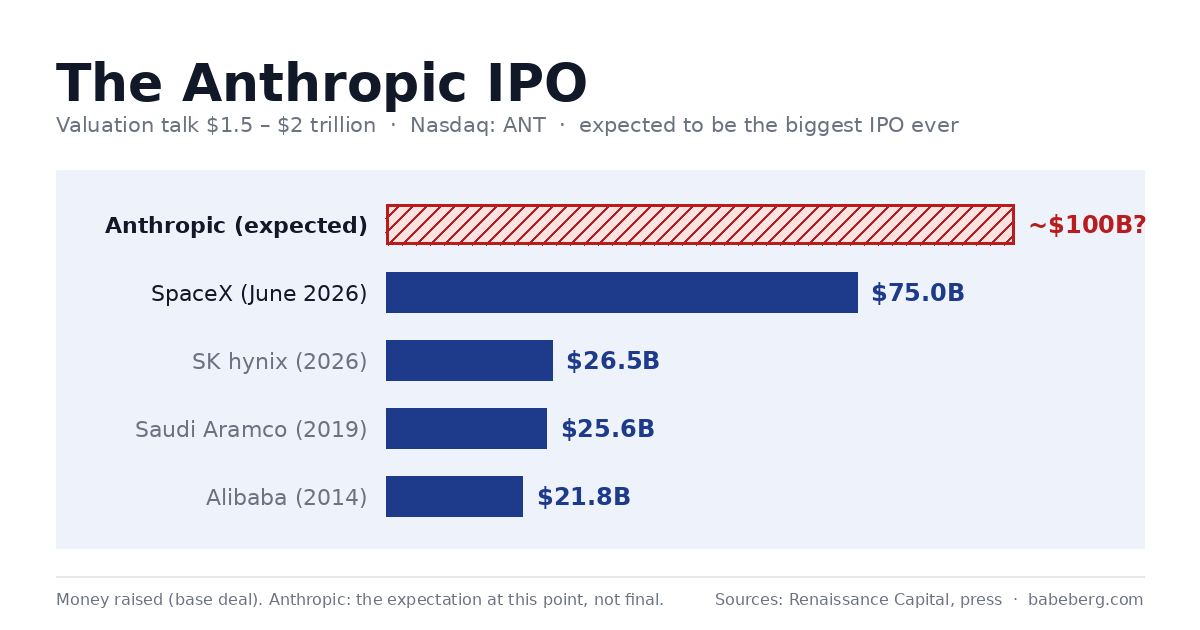
Investors are talking about a valuation of $1.5 trillion to $2 trillion. Reports say the offering could raise as much as $100 billion, which would make it the biggest IPO in history, ahead of SpaceX's record listing in June.
A caveat: that is the expectation at this point, not a final number. The filing leaves the share price range and the number of shares blank, so both the valuation and the amount raised will only be known once the deal is priced. Analysts expect it as early as November.
The numbers so far
| Item | Detail |
|---|---|
| Ticker / exchange | ANT, Nasdaq Global Select Market (Class A shares) |
| Valuation talk | $1.5 trillion to $2 trillion |
| Last private valuation (May 2026) | $965 billion |
| Expected amount raised | As much as $100 billion (reported) |
| Revenue, first half of 2026 | $16.3 billion, up from $1.2 billion a year earlier |
| Revenue, all of 2025 | $4.6 billion |
| Annualized revenue run rate | Over $65 billion (late July 2026) |
| Net loss, first half of 2026 | $80.7 billion, mostly non-cash accounting charges |
| Operating income, Q2 2026 | $974 million (after a $1.7 billion operating loss in Q1) |
| Employees | About 5,300 (September 30, 2026) |
| Lead underwriters | Goldman Sachs, Morgan Stanley |
The valuation talk has already moved. Earlier reports had backers aiming for $2 trillion or more; in October the talk among prospective investors slipped toward about $1.5 trillion. Not everyone is convinced even by that: the research firm New Constructs argues the company could be worth as little as $144 billion, and has called it the "most ridiculous IPO of 2026."
Revenue, and where it is heading
Anthropic's revenue has grown faster than almost any company of its size. It brought in $4.6 billion in all of 2025, then $16.3 billion in just the first six months of 2026: about $4.7 billion in the first quarter and more than $11.5 billion in the second.
The annualized run rate shows the same climb. A run rate takes the latest month's revenue and multiplies it out to a full year, so it is a snapshot, not money already earned:
| When | Annualized run rate |
|---|---|
| End of 2025 | About $9 billion |
| April 2026 | Over $30 billion |
| May 2026 | $47 billion |
| Late July 2026 | Over $65 billion |
Projected revenue. Anthropic does not give a revenue target in its filing. It says only that it expects its growth rate "to decline over time." Outside forecasters have filled the gap: FutureSearch, an independent forecasting firm, projects an annualized run rate of about $115 billion by May 2027, with a range of $85 billion to $162 billion. That is an outside estimate, not a company figure.
The large net loss needs explaining. Of the $80.7 billion lost in the first half of 2026, most came from non-cash accounting charges, not money going out the door. The business itself turned an operating profit in the second quarter. Anthropic does spend heavily on computing power: $8.9 billion on chips and other infrastructure in the first half of 2026, up from $2.3 billion a year earlier.
How it compares with SpaceX
SpaceX holds the current record. It priced its IPO on June 11, 2026 at $135 a share, selling about 555.6 million shares for $75 billion, at a valuation of $1.77 trillion. It trades on Nasdaq as SPCX, and closed its first day up 19%, near $161. Counting the extra shares sold to the underwriters afterwards, SpaceX raised about $86 billion.
| IPO | Year | Money raised (base deal) |
|---|---|---|
| Anthropic | 2026 | ~$100 billion (expected) |
| SpaceX | 2026 | $75.0 billion |
| SK hynix | 2026 | $26.5 billion |
| Saudi Aramco | 2019 | $25.6 billion |
| Alibaba | 2014 | $21.8 billion |
If Anthropic raises close to $100 billion, it would beat SpaceX by about a third, and be roughly four times the Saudi Aramco record that stood from 2019 until this June. The valuations would be in the same league too: SpaceX at $1.77 trillion at its IPO price, Anthropic talked about at $1.5 trillion to $2 trillion. Again, the Anthropic figures are the expectation at this point; SpaceX's are final.
What Anthropic does
Anthropic is an AI research and safety company, founded in 2021 by Dario Amodei (now CEO), Daniela Amodei (President) and several colleagues who left OpenAI. It is organized as a public benefit corporation. Its product is Claude, a family of AI models and the assistant built on them, which can write, summarize, analyze documents and data, answer questions and write software.
Anthropic makes money in two main ways:
- Subscriptions. People and companies pay a monthly or annual fee to use the Claude apps on the web, desktop and phone, and Claude Code, its tool for programmers.
- Usage-based API access. Developers and businesses build Claude into their own products and pay for how much they use, either directly from Anthropic or through cloud platforms such as Amazon Web Services and Google Cloud.
The current subscription prices:
| Plan | Price |
|---|---|
| Free | $0 |
| Pro | $20 a month, or $17 a month billed annually ($200 a year) |
| Max | From $100 a month |
| Team, standard seat | $25 per person a month, or $20 billed annually |
| Team, premium seat | $125 per person a month, or $100 billed annually |
| Enterprise | Annual contracts only: $20 per seat a month (20-seat minimum), plus usage at API rates |
The filing also shows an unusual ownership structure. The shares sold to the public are Class A, one vote each. A special Class T share is held by Anthropic's Long-Term Benefit Trust, which elects directors making up a majority of the board. A Class F share held by the seven co-founders carries 50.1% of the total voting power. Public shareholders will own part of the company, but will not control it.
What an IPO is
An IPO, or initial public offering, is the first time a private company sells its shares to the general public on a stock exchange. Before an IPO, a company is owned by its founders, employees and private investors such as venture capital firms, and its shares cannot be bought by ordinary investors. After the IPO, anyone with a brokerage account can buy and sell them.
The usual steps:
- The company files a registration statement with the U.S. Securities and Exchange Commission, called an S-1. It lays out the business, its finances and its risks. Anthropic first filed one confidentially in June and made it public on October 26.
- Investment banks underwrite the deal. They help set the price, line up buyers and agree to sell the shares.
- The roadshow. The company and its bankers pitch the shares to large investors, which shows how much demand there is.
- Pricing. The night before trading begins, the company and its bankers set the final share price and number of shares.
- Listing. The shares start trading on the exchange, where the market sets the price from then on.
Why companies go public
- To raise money. Selling new shares brings in cash for growth: for Anthropic, mainly the computing power needed to train and run its models.
- To let early owners sell. Founders, employees and early investors can turn their shares into cash.
- To create a currency. Publicly traded stock can be used to pay employees and buy other companies.
- Credibility and visibility. Public companies report their finances openly, which can reassure customers, partners and lenders.
Going public has costs too: the company must publish detailed results every quarter, answer to public shareholders, and live with a share price that can swing sharply.
Sources
- CBS News: Anthropic files for IPO, touting AI's ability to "improve how humans live"
- Yahoo Finance: Anthropic IPO live updates, S-1 filing discloses $16.3B in first-half revenue, plans to list as "ANT"
- FinanceFeeds: Anthropic S-1, $16.3B H1 revenue, Nasdaq ticker ANT
- NPR: AI giant Anthropic files for an IPO that could break records
- U.S. News: The Anthropic IPO by the numbers
- Yahoo Finance: Anthropic revenue run rate hits $65 billion ahead of IPO
- FutureSearch: Anthropic revenue, ARR and valuation forecast, 2026 to 2027
- The Next Web: Research firm calls Anthropic the "most ridiculous IPO of 2026"
- Wikipedia: Initial public offering of SpaceX
- Renaissance Capital: Largest global IPOs by deal size
- Claude pricing

0 Comments
No comments yet. Be the first!
Leave a Comment